

C++ is a high-performance programming language renowned for its fast speed, low-level memory management capabilities, and versatility. Frequently taught as a first programming language, it powers everything from operating systems and embedded devices to high-frequency trading platforms. With syntax similar to C, Java, and C#, C++ remains an essential skill for developers building performance-critical applications.
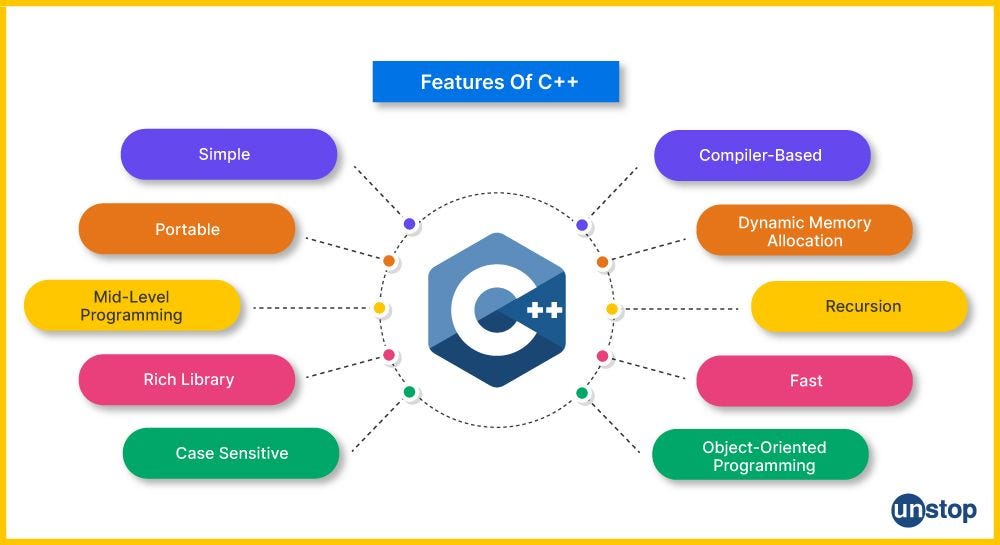
C++ combines low-level memory control with high-level object-oriented features, making it ideal for performance-critical applications.
Key Takeaways
- Blazing Fast Speed: C++ provides one of the fastest execution speeds among high-level languages, critical for competitive programming and high-performance applications.
- Low-Level Memory Management: Offers manual memory control through pointers and dynamic allocation/deallocation operators.
- Versatile Applications: Used for operating systems, embedded systems, graphical user interfaces, and High-Frequency Trading (HFT) systems.
- Object-Oriented Programming: Supports classes, objects, encapsulation, inheritance, polymorphism, and abstraction.
- Standard Template Library (STL): Provides ready-to-use data structures (vectors, lists, stacks, maps) and algorithms.
- Syntax Familiarity: Similar syntax to C, Java, and C# makes it easier to switch between these languages.
What Makes C++ Unique?
C++ occupies a unique space in the programming world. Unlike languages that prioritize ease of use over performance, C++ gives developers fine-grained control over system resources. It supports both low-level features (like manual memory management) and high-level abstractions (like Object-Oriented Programming), making it suitable for everything from firmware to complex game engines and financial trading systems.
"C++ is a programming language known for its fast speed, low level memory management and is often taught as first programming language."
— GeeksforGeeks C++ Programming Guide
Performance & Control
- One of the fastest execution speeds among high-level languages.
- Manual memory management using pointers and dynamic allocation.
- Ideal for competitive programming and real-time systems.
- Powers High-Frequency Trading (HFT) platforms.
Diverse Application Domains
- Operating systems and kernel development.
- Embedded systems and IoT devices.
- Graphical user interfaces (GUIs).
- Game engines and real-time simulations.
📚 Core C++ Learning Modules
🏁 1. Basics
This section guides you through writing your first program, managing data, performing different operations, and controlling the flow of the program. Essential for building a solid foundation in C++ syntax and structure.
🔄 2. Functions
Functions allow you to divide programs into multiple blocks, each performing a specific task. This module teaches you how to write modular and reusable code, improving maintainability and reducing duplication.
📦 3. Compound Data Types
Compound data types are created from built-in data types. This module covers essential types such as arrays, strings, pointers, and structures that help manage complex real-world data efficiently.
🧠 4. Dynamic Memory Management
C++ allows low-level memory manipulation using pointers and dynamic memory allocation/deallocation operators. This section guides you through the basics of manual memory control, a key differentiator from garbage-collected languages.
👨💻 5. Object Oriented Programming (OOP)
This section covers key OOP concepts including classes, objects, encapsulation, inheritance, polymorphism, and abstraction. These principles enable code reuse, scalability, and better organization.
📚 6. Standard Template Library (STL)
STL is an in-built library that provides a set of commonly used data structures (vectors, lists, stacks, queues, maps) and algorithms. It enhances productivity and performance by eliminating the need to reinvent common components.
⚠️ 7. Exception Handling
Exception handling techniques manage runtime errors efficiently. This module covers how to handle exceptions to prevent crashes and improve the reliability and robustness of applications.
📁 8. File Handling
File handling allows programs to store and retrieve data from files using streams. This section introduces reading from and writing to files, essential for persistent data storage applications.
🚀 9. Advanced Concepts
This section covers advanced C++ concepts such as move semantics, preprocessor directives, and multithreading. Mastering these topics allows developers to write efficient, high-performance C++ applications.
📊 C++ Learning Path & Resources
🎯 Skill Assessments
- Test what you've learned through C++ using a series of skill assessment tests.
- Evaluate your understanding of core concepts and advanced topics.
- Identify areas that need further study and practice.
💼 Interview Preparation
- Quickly prepare for C++ interviews with a curated list of commonly asked questions.
- Covers both fundamental concepts and advanced scenarios.
- Ideal for job seekers targeting C++ developer roles.
⚠️ Challenges & Considerations
- Steep Learning Curve: Manual memory management and pointer manipulation can be challenging for beginners compared to garbage-collected languages.
- Complex Syntax: C++ syntax is rich and complex, with multiple ways to accomplish the same task, which can be overwhelming.
- Memory Management Responsibility: Improper memory handling leads to leaks, dangling pointers, and undefined behavior.
- Compilation Speed: Large C++ projects can have slow compilation times, especially with heavy template usage.
- Platform Dependency: Some C++ features are platform-specific, requiring careful consideration for cross-platform development.
💡 The Bottom Line
C++ remains an indispensable language for developers who need maximum performance and hardware control. From operating systems and game engines to high-frequency trading platforms, C++ powers the most demanding applications. While the learning curve is steep, mastering C++ provides a deep understanding of computer architecture and memory management that benefits developers in any language. For performance-critical projects, C++ is often the only choice.