
Ruby is a dynamic, open-source programming language celebrated for its simplicity and extraordinary productivity. Often described as a language for developers' happiness, its elegant syntax feels natural to read and write, allowing programmers to focus on solving problems rather than wrestling with complex syntax. As a pure object-oriented language, Ruby is a powerful and flexible choice for web development, scripting, and more.
Ruby's focus on simplicity and productivity makes it a joy to use for developers.
Key Takeaways
- Pure Object-Oriented: Every piece of data, from numbers to classes, is an object, leading to a consistent and powerful programming model.
- Dynamic & Flexible: Ruby is a dynamic language, meaning you aren't required to specify variable types. Classes and modules can be modified at runtime, offering immense flexibility.
- Human-Centric Design: Yukihiro "Matz" Matsumoto designed Ruby to be intuitive and natural, prioritizing programmer happiness and productivity over machine optimization.
- Mature Web Ecosystem: Ruby is the backbone of the world-famous Ruby on Rails web framework, one of the most productive tools for building database-backed web applications.
- Extensive Tooling: Comes with
gem, a powerful package manager, andirb, an interactive shell for testing code snippets in real-time.
Why Ruby? The Philosophy of Simplicity and Productivity
Ruby was created by Yukihiro "Matz" Matsumoto, who blended parts of his favorite languages (Perl, Smalltalk, Eiffel, Ada, and Lisp) to form a new language that balanced functional and imperative programming. However, its defining characteristic is its human-centric philosophy. Matz stated he designed Ruby to be "natural, not simple," meaning it's optimized for the programmer's experience. This focus on developer happiness has made Ruby a beloved language for beginners and experts alike who value clean, readable, and maintainable code.
"Ruby is a language of careful balance. Its creator, Yukihiro ‘Matz’ Matsumoto, blended parts of his favorite languages (Perl, Smalltalk, Eiffel, Ada, and Lisp) to form a new language that balanced functional and imperative programming."
— ruby-lang.org Official Documentation
The Principle of Least Surprise
- Ruby code behaves in a way that is intuitive and predictable for the programmer.
- The syntax is designed to follow the principle of least astonishment, reducing cognitive load.
- Focuses on "programmer happiness" and high productivity.
The gem Command
- Ruby comes pre-equipped with the
gemcommand, a standard package manager. - It makes installing, updating, and sharing libraries (gems) incredibly simple.
- Provides access to a vast ecosystem of open-source solutions for almost any programming task.
⚙️ Getting Started: Your First Steps with Ruby
The official Ruby website provides several avenues for both newcomers and experienced developers to start their journey. The focus is on practical, hands-on learning.
💻 1. Interactive Ruby (irb)
irb is a Read-Eval-Print Loop (REPL) that ships with Ruby. It allows you to type Ruby code and see the result immediately. It's the perfect sandbox for experimenting with methods, classes, and language features without needing to create files.
📖 2. Official "Getting Started" Tutorial
A 20-minute interactive tutorial is available directly from the official site. This is the recommended starting point for beginners, teaching the core syntax and concepts in a hands-on, guided manner.
📚 3. Manuals & Guides
For those who prefer in-depth reading, the official "Programming Ruby" manual (a.k.a. the "Pickaxe" book) is available online. It's a comprehensive guide to all facets of the language, from basic syntax to advanced metaprogramming.
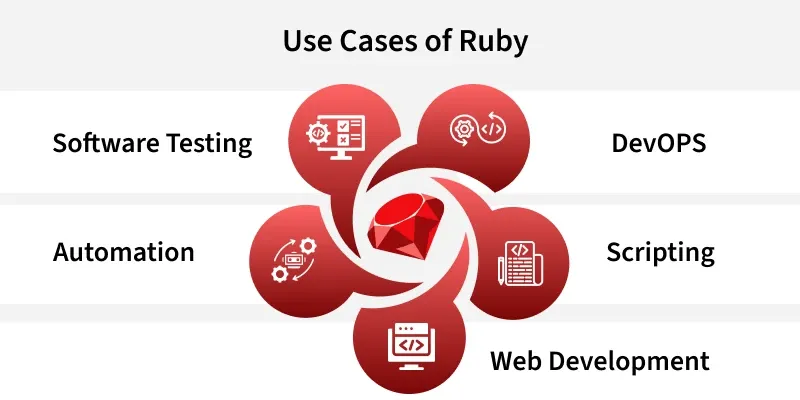
🏗️ Key Domains and Use Cases for Ruby
🌐 Web Development (Ruby on Rails)
- The Undisputed King: Ruby on Rails is a full-stack web framework that uses Ruby to create database-backed web applications with unprecedented speed.
- Convention over Configuration: Rails makes smart assumptions, drastically reducing boilerplate code.
- Notable Users: GitHub, Shopify, Airbnb, and Basecamp are built on Ruby and Rails.
🛠️ Automation & Scripting
- Powerful System Admin: Ruby's expressive syntax and rich standard library make it a fantastic upgrade from Bash or Python for automation tasks.
- DevOps Tools: World-class tools like Puppet (IT automation) and Vagrant (development environment management) are written in Ruby.
- Build Scripts & Cron Jobs: Ideal for writing complex, maintainable glue code and scheduled tasks.
⚠️ Challenges & Considerations
- Performance: Ruby is not known for raw execution speed, a trade-off for its dynamic and flexible nature. For CPU-intensive tasks, it may not be the best tool.
- Concurrency Model: The Global Interpreter Lock (GIL) can be a limitation for true parallel threading, although concurrency is possible.
- Learning Curve for Metaprogramming: While powerful, Ruby's advanced metaprogramming features can be difficult for newcomers to understand and debug.
- Mobile Development: Ruby is not a primary language for native iOS or Android development.
💡 The Bottom Line
Ruby is more than just a programming language; it's a philosophy built around developer happiness and productivity. While it may not be the fastest language, its elegant syntax, powerful tools like irb and gem, and the legendary Ruby on Rails framework make it an exceptionally effective choice for web development and scripting. It's a language that prioritizes the human over the machine, making complex projects feel surprisingly simple.