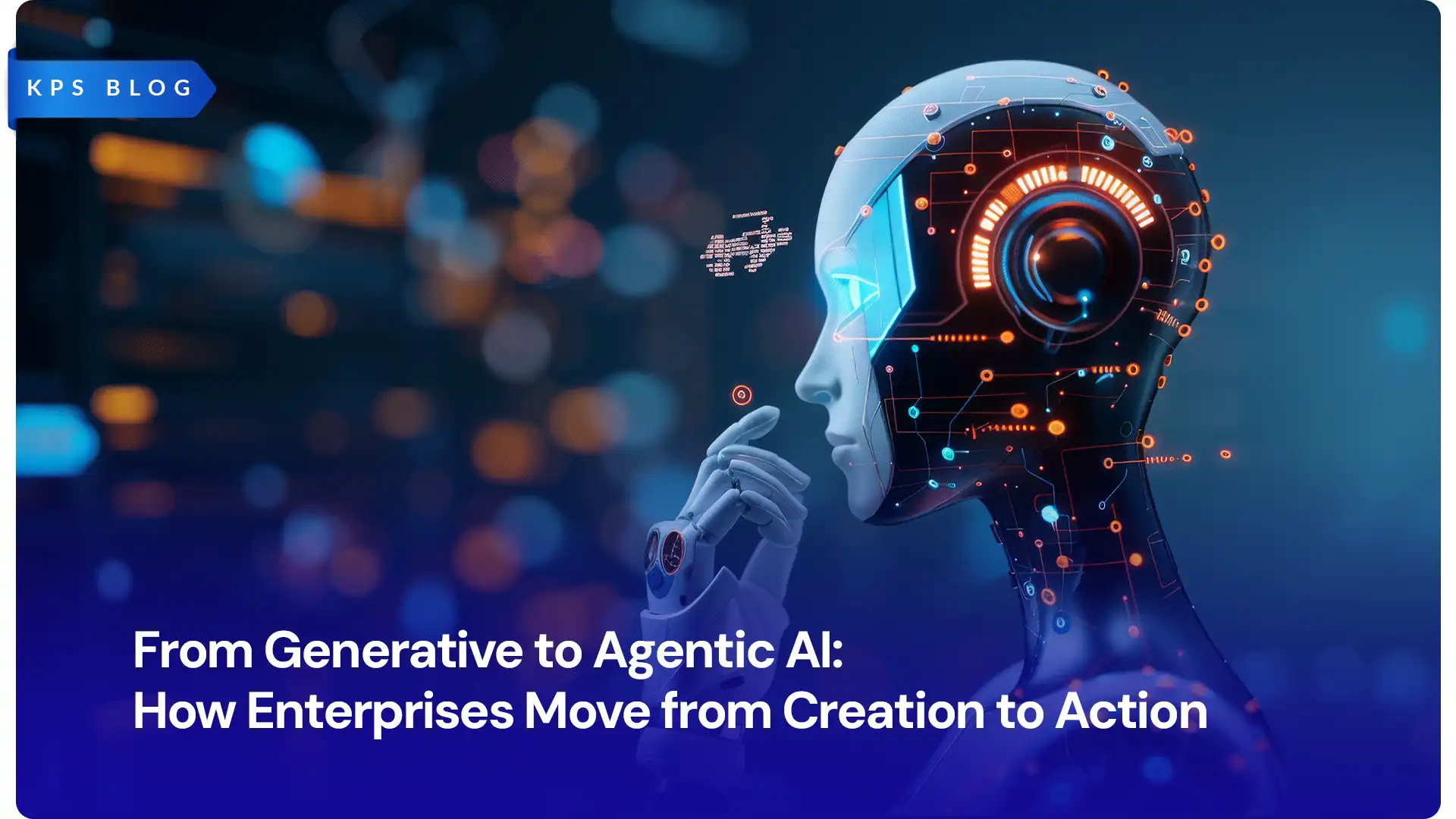
Artificial Intelligence is evolving at a breathtaking pace. A few years ago, the conversation revolved around Predictive AI. Then Generative AI captured the world's imagination. Now, a new wave is rising: Agentic AI. Each type plays a distinct role—one predicts, one creates, and one executes. Understanding how they differ and work together is key to understanding the future of intelligent systems.
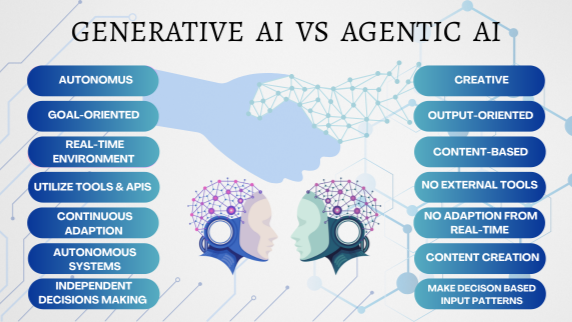
The three stages of AI: from analyzing the past to creating the new, and finally acting autonomously.
Key Takeaways
- Predictive AI analyzes past data to forecast future outcomes, like recommendations and fraud detection.
- Generative AI creates new content—text, images, code—by learning patterns from massive datasets.
- Agentic AI takes autonomous action to achieve complex goals, using reasoning, memory, and external tools.
- These three AI types aren't rivals but complementary stages of intelligence: insight (Predictive), creation (Generative), and action (Agentic).
- Together, they form a complete loop, enabling systems that can learn, create, and act like a human but faster and at scale.
What is Predictive AI?
Predictive AI is the oldest and most widely used form. Its core job is simple: look at past data and predict what might happen next. It learns from user patterns—like shopping habits, daily routines, or stock prices—to forecast the next step. It's all about making smart guesses based on what already exists.
Examples You've Seen:
- YouTube suggesting songs you will probably love.
- Banks detecting suspicious transactions before fraud happens.
- Weather apps forecasting rain before you feel a drop.
- Netflix recommending your next binge-watch.
Historical Note: Predictive AI has roots in the 1950s with early neural networks like the perceptron. It matured through the 1990s with statistical models and today powers everything from self-driving cars to inventory management.
What is Generative AI?
Generative AI represents the big leap from observation to imagination. These systems don't just analyze; they create entirely new content—text, art, music, code, and even videos—by learning patterns from massive amounts of data. You give it a prompt, and it generates something new. It feels more human because it can mimic creativity.
Popular Examples:
- ChatGPT writing blogs or explaining complex topics.
- Midjourney or DALL·E creating realistic images from a few words.
- Gemini and Claude writing stories or summaries in seconds.
- GitHub Copilot generating code from comments.
Historical Note: While early chatbots like ELIZA appeared in the 1960s, modern Generative AI arrived in the late 2010s with GANs and transformers. By 2022, cloud computing made it accessible, sparking the global AI boom.
Limitation: It doesn't take initiative. It only responds when you ask. It won't decide what needs to be done next.
What is Agentic AI?
Agentic AI is the new frontier: AI that can act on command. It uses reasoning, memory, and external tools to perform real-world tasks autonomously, with minimal human intervention. Think of it as an AI that not only writes an email but also sends it, tracks replies, and schedules a follow-up meeting, all by itself. It blends the creativity of Generative AI with the logic of Predictive AI to plan, decide, and execute goals.
Emerging Examples:
- AutoGPT and Devin managing multi-step projects.
- ChatGPT with Actions browsing, fetching data, or running workflows.
- Perplexity as an agentic browser that understands intent and autonomously handles tasks.
- AI agents in customer support that resolve tickets or process refunds automatically.
Historical Note: The concept of intelligent agents began in the 1950s, but Agentic AI as we know it rose between 2023 and 2025. By 2024, the term became mainstream, and by 2025, enterprise platforms turned agentic systems into real-world automation tools.
How They Connect: From Insight to Action
These three types of AI are not rivals. They are the three stages of AI evolution, a complete loop of intelligence.
Predictive AI
The brain that analyzes behavior and
predicts trends.
Generative AI
The mind that creates content and
generates results.
Agentic AI
The body that completes tasks
autonomously.
"Together, they form a complete loop of intelligence. Predictive AI gives us insight. Generative AI gives us content. Agentic AI gives us action. When all three come together, you get a system that can learn, create, and act, just like a human, but faster, more precise, and endlessly scalable."
Example in Action: A Marketing AI Agent
- The Predictive layer analyzes audience behavior and predicts trends.
- The Generative layer writes catchy ad copy and designs visuals.
- The Agentic layer launches the campaign, monitors results, and tweaks the strategy automatically.
This combination turns AI from a tool into a teammate—one that can handle end-to-end work without needing you to hold its hand at every step.
Quick Comparison: Agentic AI vs Generative AI vs Predictive AI
| Aspect | Predictive AI | Generative AI | Agentic AI |
|---|---|---|---|
| Core Purpose | Forecasts outcomes based on past data | Creates new and original content | Takes autonomous actions to achieve goals |
| Main Function | Analyze and predict trends | Generate text, images, code, or music | Plan, reason, and execute multi-step tasks |
| Data Dependency | Historical data and analytics | Large datasets for training patterns | Contextual data, memory, and live feedback |
| Human Involvement | High – needs guidance on what to predict | Medium – responds to user prompts | Low – executes goals with minimal input |
| Examples | Netflix recommendations, fraud detection | ChatGPT, DALL·E, Midjourney | AutoGPT, Devin, ChatGPT with Actions |
| Industries Using It | Finance, marketing analytics, healthcare | Media, design, education, software | Automation, customer service, research |
💡 The Bottom Line
The future of AI is not about choosing one type over another. It's about how Predictive, Generative, and Agentic AI work together to create systems that are more insightful, creative, and capable than any single one alone. Predictive helps you understand what might happen. Generative helps you explore what could exist. Agentic helps you achieve what should be done.
Key Takeaways
- •This article highlights the latest trends in document technology
- •Practical insights for implementing PDF solutions in your workflow
- •Expert recommendations for document security and management