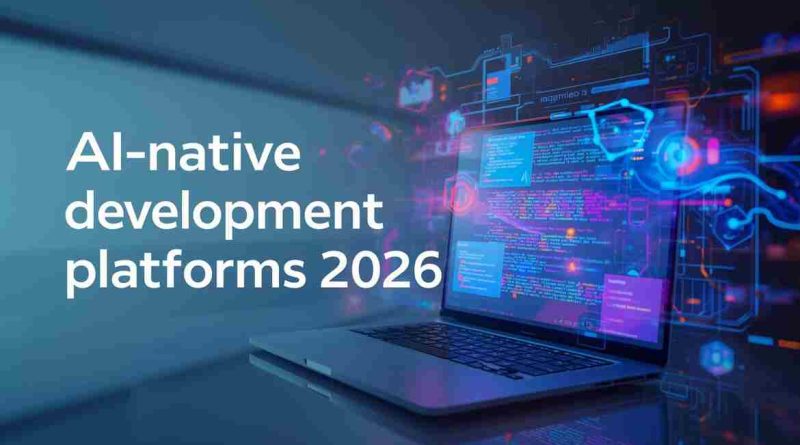
Software development is undergoing a major transformation. The next-generation development approach integrates cloud-native technologies, AI-driven automation, collaborative tools, and DevSecOps practices. AI-native Software Development Lifecycle (SDLC) is rapidly evolving where AI-driven tools are delivering improvements in developer productivity, code quality, reduced development time, and accelerated innovation.
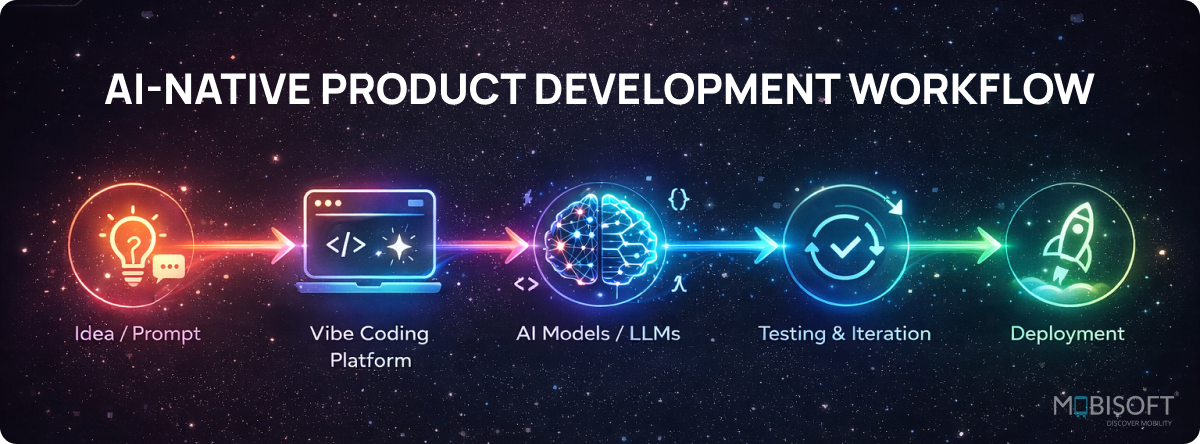
Referance By: https://medium.com/lets-code-future/best-vibe-coding-platforms-for-building-ai-native-products-ed85b2fbdc33
AI is transforming every phase of the SDLC, from requirements gathering to maintenance and monitoring.
Key Takeaways
- According to Gartner, 70% of developers will use AI tools by 2027, and 60% of enterprise AI rollouts will have agentic capabilities.
- From 2023-2025, GitHub observed 920% growth in usage of agentic frameworks like AutoGPT, BabyAGI, Crew AI, and OpenDevin.
- AI impact varies by phase: Coding and testing see medium impact; requirements and design currently see lower AI applicability.
- Agentic AI represents the next evolution—autonomous systems that can independently perform multi-step development tasks.
- Key AI coding tools include GitHub Copilot (Agentic mode), Amazon Q, Google Gemini Code Assist, Tabnine, and Codeium.
- AI testing tools excel at UI automation but have limitations with API and complex logic testing.
- The future is human-AI collaboration, with developers transitioning from manual coders to AI orchestrators.
Why Human-Centric SDLC is Holding Us Back
In traditional human-centric SDLC, extensive manual processes create inefficiencies and slow down development time. These repetitive processes involving low-level tasks like code generation, testing, and bug fixing make development time-consuming and prone to human errors. Leveraging AI brings productivity improvements that developers can utilize for higher-value pursuits.
"The future of software development is being transformed by AI-native engineering. AI is gradually transforming SDLC by automating repetitive tasks and enhancing productivity, though its effectiveness varies across phases."
— Infosys Knowledge Institute
📊 AI-Augmented Development Workflow
The impact of AI across SDLC phases varies significantly. Here's how each phase is being transformed:
| Phase | AI Impact | AI Applicability | Status |
|---|---|---|---|
| Requirement | Analyzes historical data to suggest requirements, user stories | Low | Requires manual refinement for complex needs |
| System Design | Generates architectural blueprints, UX designs from templates | Low | Best for prototyping; not reliable for detailed design |
| Coding & Implementation | Code generation, suggestions, reviews, refactoring, documentation | Medium | Requires clear prompts; manual refinement for precision |
| Testing & Debugging | Test case generation, bug detection, visual testing | Medium | Useful for UI; limited for API/complex logic |
| Deployment | Streamlined deployments, automated scripts, CI/CD optimization | Low | Requires manual oversight and validation |
| Maintenance & Monitoring | Predictive maintenance, anomaly detection, log analysis | Low | Emerging but lacks full coverage and reliability |
🛠️ AI Tooling Landscape by Phase
📋 1. Analysis Phase Tools
AI Augmentation: Extract insights from documents, user story generation, requirement traceability, backlog grooming, timeline prediction.
Tools: IBM Watson NLP, Google Cloud NLP, Jira + Atlassian Intelligence, Copilot4DevOps, IBM Engineering Requirements Management with Watson AI
🎨 2. Design Phase Tools
AI Augmentation: UI layout generation, wireframing, prototyping, design-to-code automation, accessibility testing, UX prediction.
Tools: Figma + AI Plugin, Uizard, Visily, Galileo AI, Lucidchart AI, Miro Assist, Locofy, Anima, Stark, Neurons, Attention Insight, Adobe Firefly
💻 3. Coding Phase Tools (IDE Plugins + Chat Interface)
AI Augmentation: Code generation, completion, debugging, security scanning, unit test generation, code review, refactoring, documentation.
Primary Tools: GitHub Copilot (Agentic mode), Amazon Q (Agentic), Google Gemini Code Assist, Tabnine, Codeium, Jetbrains AI Assistant, Sourcegraph Cody
Security & Quality: Snyk (Deep Code AI), Sonarqube, Veracode, Github Advanced Security, Checkmarx One, Fortify
Documentation: Scribe, Mintlify
🧪 4. Testing Phase Tools
AI Augmentation: Automated visual testing, self-healing tests, test case creation, bug prediction, test optimization.
Tools: Testim, Applitools (Visual AI), Functionize, Selenium with AI integrations, Katalan Studio, CoTester by TestGrid, Browserstack, LambdaTest KaneAI, Mabl
Note: AI test automation mostly for UI; lacks advanced API testing features.
🚀 5. Deployment Phase Tools
AI Augmentation: CI/CD automation, IaC script writing, rollback assistance, deployment impact analysis.
Tools: Jenkins X (with AIOps), CircleCI (AI-assisted), GitHub Actions + AI agents, Harness AI, Ansible AI, Terraform AI, Azure DevOps with AI, GitLab with AI, Bitbucket + Atlassian Intelligence, Spacelift
📊 6. Maintenance & Monitoring Tools
AI Augmentation: Anomaly detection, root cause analysis, predictive insights, self-healing automation, incident management.
Tools: New Relic AI, Dynatrace (Davis AI), Datadog AI (Bita AI), Splunk AI Ops, PagerDuty, incident.io, Sysdig AI
🏗️ AI Platforms & Services in Wide Use
These enterprise-grade platforms offer end-to-end tools for building, training, deploying, and managing AI models with robust infrastructure and compliance:
Access to pre-trained models (Claude, Llama, Titan) via API
Full ML platform for training, tuning, and deploying custom models
Secure access to GPT-4o, DALL·E, Codex with enterprise governance
Unified platform for building and managing AI agents with multi-agent orchestration
End-to-end platform for building, training, and deploying models
AI tools integrated into Google Cloud and Workspace
Direct API access to GPT-4o, DALL·E, Whisper, Codex
Foundation models, governance, and ML lifecycle for responsible AI
🤖 Agentic AI: The Next Frontier
Agentic AI represents autonomous systems that can independently perform complex multi-step tasks, unlike standard GenAI tools that passively respond to queries. This is capable of:
Example: GitHub Copilot Agentic Mode
- Autonomous: Performs multi-step coding tasks from a single natural language prompt
- Comprehensive: Runs tests, formats and refactors code, executes commands
- Context-Aware: Understands full codebase context, not just snippets
- Iterative: Operates an "agentic loop" to iteratively refine its work
⚠️ Considerations for Evaluating AI Models
- API Availability for existing systems
- Tooling and SDKs (IDE plugins)
- Community and vendor support
- Model choice (LLM vs SLM)
- Fine-tuning capability
- Open-source vs proprietary
- Usage cost (pay-per-token/subscription)
- Infrastructure cost for on-prem
- Cost-effectiveness at scale
- Data retention policies
- Legal compliance (GDPR, HIPAA)
- Self-hosting options
🚨 Risks, Challenges & Mitigations
Non-enterprise LLMs may leak prompts and code in future updates.
Mitigation: Use proprietary enterprise LLMs like GitHub Copilot, AWS Q, Google Codey.
AI struggles with novelty, complexity, and deep business logic.
Mitigation: Combine AI with human expertise for architecture and complex solutions.
False positives/negatives, inconsistent suggestions, insecure coding practices.
Mitigation: Human review, clear prompts, mandatory code quality and security scans.
Dependency on human expertise for validating AI output.
Mitigation: Recognize and budget for human validation as part of the process.
Need for transparency, bias mitigation, and regulatory compliance.
Mitigation: RLHF, guardrails, prompt moderation, adhere to GDPR and AI Act.
📈 Implementation Plan for AI Integration
Foundational tools and low-risk experiments
Test AI in low-risk projects
Expand to broader use cases
Transition to autonomous systems
🔮 The Future: Evolving Roles and Methodologies
Vibe Coding
An emerging AI-assisted approach where developers use natural language to guide Large Language Models (LLMs) to create code.
Augments developer capabilities (Most prevalent)
Engages in dialogue with developers (Emerging)
Performs tasks autonomously (Early stages)
💡 The Bottom Line
The future of software development is not humans versus AI—it's human and AI collaboration. Each contributes unique strengths that neither could produce alone. As developers transition from manual coders to AI orchestrators, their focus will shift toward designing intelligent systems, integrating automation, and upholding ethical and secure software practices.