Node.js is a cross-platform, open-source JavaScript runtime environment that executes JavaScript code outside a web browser. Built on Chrome's V8 JavaScript engine, it has become one of the most commonly used web technologies, enabling a "JavaScript everywhere" paradigm that unifies web-application development around a single programming language.
Node.js allows developers to use JavaScript on the server, creating fast, scalable network applications.
Key Takeaways
- Node.js is a cross-platform, open-source JavaScript runtime built on Chrome's V8 engine, executing JS code outside a browser.
- It features an event-driven architecture with asynchronous I/O, optimizing throughput and scalability for real-time applications.
- Created by Ryan Dahl in 2009, it has evolved under the OpenJS Foundation (a merger of Node.js and JS Foundations).
- Node.js uses an event loop, allowing it to handle many concurrent connections without traditional threading overhead.
- Its package manager, npm, is the largest ecosystem of open-source libraries, with thousands of tools and frameworks available.
- The project has a predictable, long-term support (LTS) release cycle, with new major versions every six months.
What is Node.js?
Node.js is more than just a runtime; it's a fundamental shift in how developers build web applications. By allowing JavaScript to run on servers, it enables developers to use a single language across both the client and server sides of an application. This unification simplifies development, reduces context switching, and allows for code sharing between frontend and backend.
"Node.js represents a 'JavaScript everywhere' paradigm, unifying web-application development around a single programming language, as opposed to using different languages for the server- versus client-side programming."
— Node.js Official Documentation
Event-Driven & Non-Blocking
- Node.js uses an event-driven architecture capable of asynchronous I/O.
- This design optimizes throughput and scalability in web applications with many I/O operations.
- Ideal for real-time Web applications (e.g., communication programs and browser games).
- Unlike traditional servers, Node.js doesn't create a new thread for each request.
npm: The Package Manager
- npm, introduced in January 2010, is the pre-installed package manager for Node.js.
- It allows developers to publish, share, and install Node.js packages with ease.
- npm simplifies installation, updates, and uninstallation of third-party modules.
- It's the largest ecosystem of open-source libraries in the world.
Cross-Platform Support
- Officially supports Linux, macOS, Windows 8.1/Server 2012, and later.
- Tier 2 support for SmartOS and IBM AIX.
- Experimental support for FreeBSD and OpenBSD.
- LTS versions available for IBM i (AS/400) and NonStop OS.
Open Governance
- Governed by the OpenJS Foundation (merged Node.js Foundation & JS Foundation in 2019).
- Facilitated by the Linux Foundation's Collaborative Projects program.
- Technical Steering Committee (TSC) oversees core development.
- Long Term Support (LTS) Working Group manages release strategy.
📜 History & Evolution
⏳ 1. The Birth of Node.js (2009)
Ryan Dahl initially wrote Node.js in 2009, about 13 years after the first server-side JavaScript environment (Netscape's LiveWire Pro Web). Dahl was frustrated with limitations of servers like Apache HTTP Server to handle many (10,000+) concurrent connections. He demonstrated Node.js at the inaugural European JSConf on November 8, 2009, combining Google's V8 engine, an event loop, and a low-level I/O API.
🔄 2. Growth & Governance (2010-2014)
In January 2010, npm (package manager) was introduced. By June 2011, Microsoft and Joyent implemented a native Windows version. Ryan Dahl handed over project management to npm creator Isaac Schlueter in January 2012. In December 2014, Fedor Indutny created io.js, a fork of Node.js, due to dissatisfaction with Joyent's governance, aiming for a more open structure.
🤝 3. The Great Merger (2015)
The Node.js Foundation was announced in February 2015 to reconcile Node.js and io.js. The merger was realized in September 2015 with Node.js v0.12 and io.js v3.3 combining into Node v4.0. This merge brought V8 ES6 features into Node.js and started the Long-Term Support (LTS) release cycle, establishing the predictable release cadence used today.
✨ 4. Modern Era (2019-Present)
In 2019, the JS Foundation and Node.js Foundation merged to form the OpenJS Foundation. Since version 22.6.0, Node.js natively supports both JavaScript and TypeScript, allowing TypeScript files to be executed without a separate compilation step—a contribution from TSC member Marco Ippolito.
🔧 Platform Architecture & Technical Details
🔄 The Event Loop & Threading
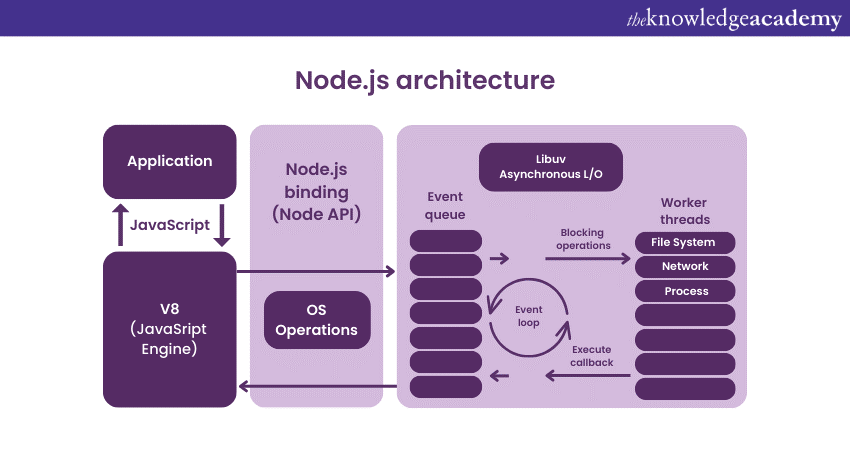
- Single-Threaded: Node.js operates on a single-thread event loop using non-blocking I/O calls.
- High Concurrency: Supports tens of thousands of concurrent connections without thread context switching overhead.
- libuv: Handles asynchronous events and uses a fixed-sized thread pool for non-blocking operations.
- Thread Pool: Handles parallel tasks; inherently blocking functions (like file I/O) run on their own threads.
- Limitation: Long-running CPU-bound tasks can freeze the event loop until completion.
⚙️ Core Components & Bindings
- V8 Engine: JavaScript execution engine from Google Chrome, compiles JS to native machine code at runtime.
- libuv: Abstraction layer for network and file system functionality on Windows and POSIX systems.
- N-API: C-based API for creating native add-ons (C/C++) that can be loaded as CommonJS modules.
- Additional Libraries: Uses ada (URL compliance), simdutf (Unicode), simdjson (JSON parsing), nghttp2 (HTTP support).
- WebAssembly: Supports WebAssembly, with experimental WASI support since Node 14.
🗓️ Release Cycle & LTS Strategy
Node.js has a predictable, time-based release schedule that balances innovation with stability:
New major releases cut from GitHub main branch in April (even-numbered) and October (odd-numbered).
Even versions get Long Term Support: 12 months active + 18 months maintenance.
Active LTS receives non-breaking backports. Maintenance receives only critical fixes.
Current Release Status (as of late 2025/early 2026)
- Node.js 20.x (Iron): Maintenance LTS, supported until April 2026.
- Node.js 22.x (Jod): Maintenance LTS, supported until April 2027.
- Node.js 24.x (Krypton): Active LTS (latest version), supported until April 2028.
- Node.js 25.x: Current (preview) release, expected end-of-life June 2026.
- Node.js 26.x (Lithium): Planned release for 2026, future LTS.
This predictable schedule allows enterprises and developers to plan upgrades and rely on stable, long-term supported versions.
🏗️ Industry Support & Ecosystem
Express.js, Socket.IO, Sails.js, Next.js, and Meteor are popular frameworks that accelerate Node.js application development.
Visual Studio Code, WebStorm, Atom, Brackets, and NetBeans provide excellent Node.js debugging and editing support.
Supported on AWS Elastic Beanstalk, Azure Web Apps, Google Cloud Platform, Jelastic, and Joyant.
⚠️ Considerations & Limitations
- CPU-Bound Tasks: Long-running computations freeze the event loop until completion, making Node.js less suitable for heavy CPU-intensive workloads (like image processing or complex math).
- Vertical Scaling: Node.js doesn't automatically scale across CPU cores without additional modules like cluster, StrongLoop Process Manager, or pm2.
- Callback Hell: Heavy reliance on callbacks historically led to deeply nested code, though Promises and async/await have largely mitigated this issue.
- Maturity: While npm is vast, some packages may lack the maturity or maintenance of established libraries in other ecosystems.
💡 The Bottom Line
Node.js has transformed server-side development by bringing JavaScript's ubiquity and ease to the backend. Its event-driven, non-blocking architecture excels at I/O-bound and real-time applications, while npm provides the largest ecosystem of open-source libraries available. With a predictable LTS release cycle, strong corporate backing, and an active open-source community, Node.js remains a foundational technology for modern web development, from simple APIs to complex, real-time applications.
Key Takeaways
- •This article highlights the latest trends in document technology
- •Practical insights for implementing PDF solutions in your workflow
- •Expert recommendations for document security and management