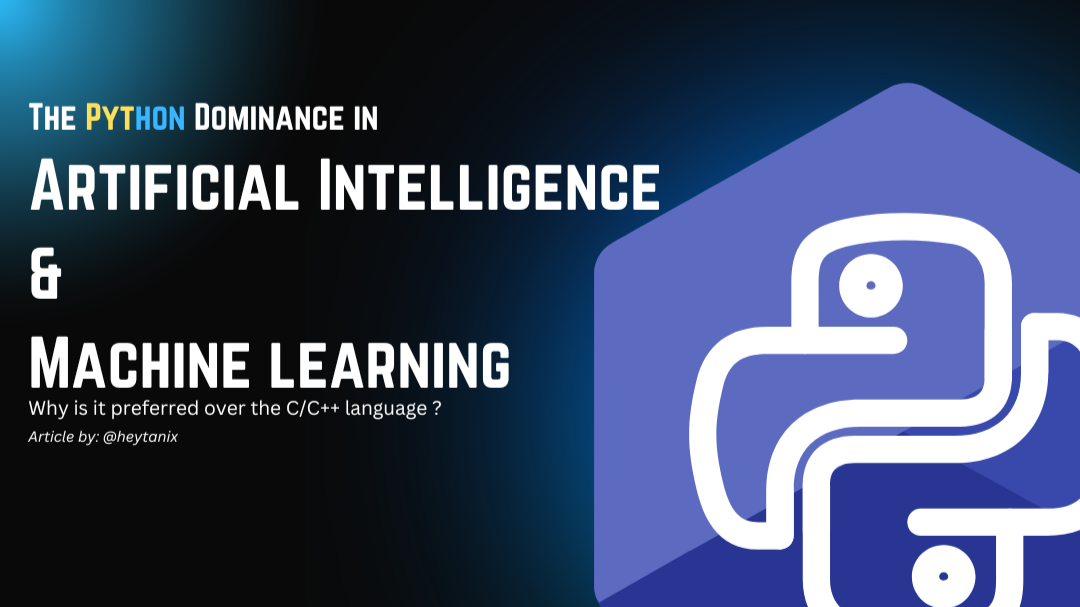
Python isn't just a programming language anymore—it's the backbone of the global AI revolution. Consistently topping the TIOBE Index and serving as the primary language for machine learning on GitHub, Python has become the "unstoppable juggernaut" of intelligent systems. From research labs to production-scale AI, Python's simplicity and power continue to drive innovation across every industry.
Python dominates as the #1 language for AI/ML, data science, and intelligent application development worldwide.
Key Takeaways
- Python leads the TIOBE Index and is the top language on GitHub for AI and machine learning projects.
- Its simple syntax and readability make it the preferred choice for both beginners and expert AI researchers.
- An unparalleled ecosystem of libraries—TensorFlow, PyTorch, scikit-learn, and Hugging Face—drives rapid AI development.
- Python is the universal glue language for modern AI stacks, connecting data ingestion, model training, and deployment.
- The language has become the standard for Generative AI, powering applications built on GPT, Llama, and Stable Diffusion.
- Python's dominance continues to grow with the rise of Agentic AI frameworks like LangChain and AutoGPT.
Why Python is the "Unstoppable Juggernaut" of AI
In the rapidly evolving landscape of artificial intelligence, one constant remains: Python. What began as a general-purpose scripting language has transformed into the undisputed backbone of modern AI and machine learning. Its rise is no accident—Python offers the perfect balance of simplicity for rapid prototyping and the depth required for production-scale systems.
"Python's dominance in AI isn't just about its syntax—it's about the community, the ecosystem, and the momentum. Every major AI breakthrough, from Transformers to Diffusion Models, arrives first with Python bindings."
— GitHub Octoverse AI/ML Report 2026
TIOBE Index Leadership
- Held the #1 position consistently since 2022.
- Rating gap over Java and C continues to widen year over year.
- Dominates in AI, data science, and academic research categories.
- Most taught first programming language in universities globally.
GitHub Dominance
- Top language for AI/ML-related repositories and contributions.
- Fastest-growing language in the open-source AI ecosystem.
- Home to PyTorch, TensorFlow, and Hugging Face's Transformers.
- Most forked and starred AI projects are Python-based.
🚀 The Ecosystem That Powers Everything
🧠 1. Deep Learning & Neural Networks
TensorFlow and PyTorch dominate the deep learning landscape. From research prototypes to production deployments at Meta, Google, and Tesla, Python powers the training and inference of billion-parameter models. Libraries like Keras provide high-level APIs that make neural networks accessible to thousands of developers.
🤖 2. Machine Learning & Data Science
scikit-learn remains the gold standard for classical ML algorithms. Combined with pandas for data manipulation, NumPy for numerical computing, and Matplotlib for visualization, Python provides an end-to-end workflow. Data scientists can explore, clean, model, and visualize without switching languages.
✨ 3. Generative AI & LLMs
Python's Hugging Face Transformers library set the standard for working with large language models. From GPT-4 to Llama 3 and Stable Diffusion, Python interfaces are always first-class citizens. LangChain has emerged as the go-to framework for building chains and agents on top of LLMs, further cementing Python's position.
🔧 4. Agentic AI & Automation
The newest wave of AI—agentic systems that plan and act autonomously—is being built almost exclusively in Python. Frameworks like AutoGPT, BabyAGI, and Microsoft's Semantic Kernel are Python-first. Developers use Python to create AI agents that browse the web, write code, and execute complex multi-step workflows.
📊 5. Computer Vision & Edge AI
OpenCV (Python bindings) is the standard for real-time computer vision. Combined with YOLO for object detection, Python powers surveillance systems, autonomous vehicles, and medical imaging. On the edge, libraries like TensorFlow Lite enable Python models to run on phones and embedded devices.
🌐 6. Web & API Integration
Frameworks like FastAPI, Django, and Flask make it trivial to deploy AI models as REST APIs. Python's requests library and asynchronous capabilities allow AI systems to connect to external tools, databases, and services—essential for modern agentic workflows and MLOps pipelines.
📚 Why Developers and Researchers Choose Python
🛠️ Technical Advantages
- Low Barrier to Entry: English-like syntax and dynamic typing shorten the learning curve.
- Interpreted Nature: Write-run-debug cycles are incredibly fast for experimentation.
- C++/CUDA Integration: Performance-critical code can be written in lower-level languages with Python bindings.
- Rich Visualization: Matplotlib, Seaborn, and Plotly enable powerful data exploration.
- Jupyter Notebooks: The interactive computing environment is beloved by researchers worldwide.
- Cross-Platform: Runs identically on Windows, macOS, Linux, and cloud environments.
🌍 Community & Momentum
- Massive PyPI Repository: Over 400,000 packages available for almost any task.
- Vibrant Open Source: Active contributions from Google, Meta, Microsoft, and thousands of individuals.
- Academic Standard: Python has replaced MATLAB as the teaching language for CS and data science.
- Corporate Backing: Anaconda, JetBrains, and Cloud providers offer enterprise-grade support.
- Continuous Evolution: Regular releases with performance improvements (Python 3.13, 3.14).
⚠️ The Few Weaknesses (And Why They Don't Matter)
- Speed concerns: While Python is slower than C or Rust, AI workloads rely on highly optimized C/C++ libraries (NumPy, PyTorch) that run at native speed. The "glue code" overhead is negligible.
- Global Interpreter Lock (GIL): True parallel threading is limited, but multi-processing and GPU acceleration solve most AI concurrency needs. (Note: Python 3.13 introduces optional GIL removal!)
- Mobile limitations: Python isn't native on iOS or Android, but models are converted to CoreML or TFLite—training stays in Python.
- High memory usage: For massive deployments, optimization is required, but the ecosystem provides tools like TensorRT and ONNX.
In practice, these weaknesses rarely outweigh the immense productivity and ecosystem benefits Python provides.
🔮 The Future: Python in 2026 and Beyond
Mojo, a Python superset designed for AI hardware, promises C-level speed while maintaining Python syntax, potentially extending Python's reign for another decade.
Cursor, Copilot, and custom LLMs now write and debug Python code. Developers shift from syntax to system design and validation.
LangChain, AutoGPT, and CrewAI are standardizing how multi-agent systems are built, all in Python.
Serverless Python (AWS Lambda, Google Cloud Functions) and containerized deployments are becoming default for AI microservices.
💡 The Bottom Line
Python is not just the most popular language—it has become the essential language for anyone working in AI, machine learning, or data science. Its ecosystem, community, and momentum make it the "unstoppable juggernaut" that defines how intelligent systems are imagined, built, and deployed. As AI continues to evolve from prediction to generation to autonomous action, Python will remain at the center, adapting and leading.
Key Takeaways
- •This article highlights the latest trends in document technology
- •Practical insights for implementing PDF solutions in your workflow
- •Expert recommendations for document security and management