
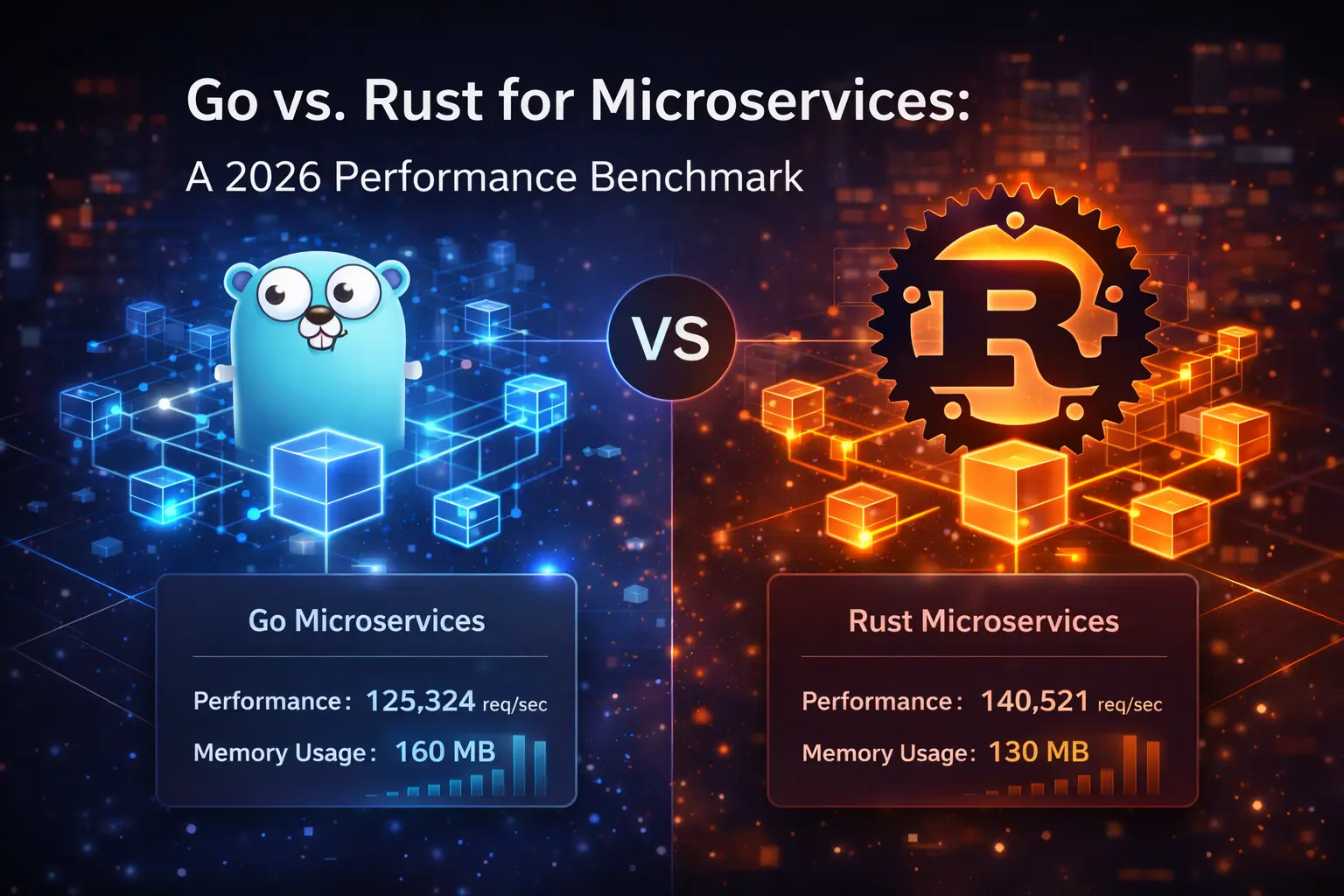
Rust and Go are two of the most compelling modern programming languages, both prioritizing memory safety, performance, and scale. However, they embody radically different design philosophies. Go champions simplicity and rapid development, making it ideal for cloud services and agile teams. Rust focuses on correctness and control without sacrificing speed, making it the go-to choice for safety-critical and high-performance systems.
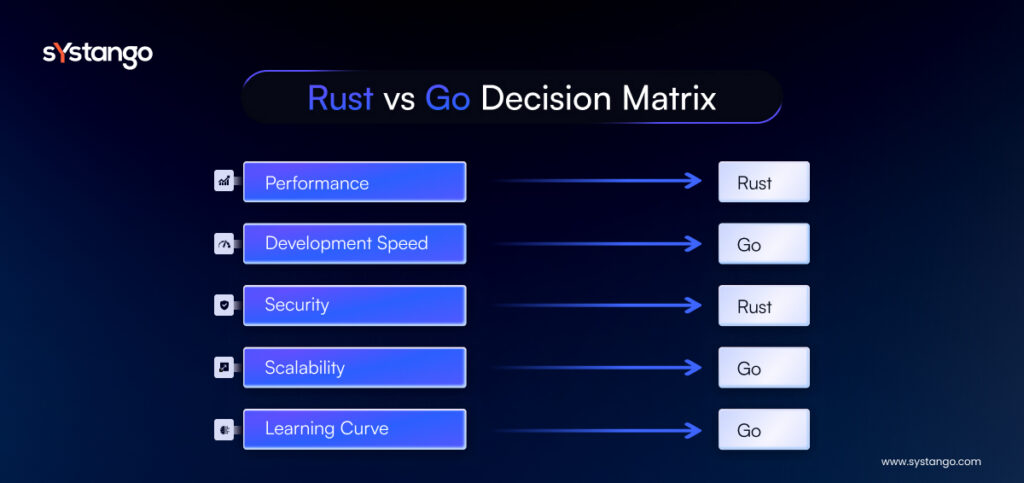
Rust and Go share common goals like memory safety and modern tooling, but differ significantly in design philosophy and ideal use cases.
Key Takeaways
- Common Goals: Both Rust and Go prioritize memory safety, modern tooling, performance, and the ability to operate reliably at global scale.
- Go's Philosophy: Focuses on simplicity (easy to learn and compile), high-level abstraction (concurrency, GC), and stability (strong backwards compatibility).
- Rust's Philosophy: Centered on correctness (eliminating bugs at compile time for safety-critical apps), raw performance (equal to C++), and low-level control.
- When to Choose Go: Ideal for rapid onboarding, fast prototyping, minimal development costs, web/cloud services, line-of-business tools, and infrastructure/SRE.
- When to Choose Rust: Best for reliability, high performance, efficient resource use, industrial automation, automotive/aerospace, and medical/healthcare applications.
- Bottom Line: Go prioritizes simplicity, scale, and speed of development. Rust prioritizes safety, correctness, and maximum performance for high-stakes systems.
Common Goals & Important Differences
Both Rust and Go are relatively modern languages that incorporate decades of software engineering lessons. They both prioritize memory safety, aiming to eliminate bugs like buffer overflows and data races common in C/C++. Both feature fast, powerful, unified toolchains and are explicitly designed for large projects and global-scale applications.
However, their design philosophies diverge significantly. Go's key priorities are simplicity (a small, easy-to-learn language), abstraction (high-level features like garbage collection), and stability (strong backwards compatibility). Rust, on the other hand, focuses on correctness (using static analysis for safety-critical applications), performance (code that runs as fast as hardware allows), and low-level control over system resources.
"Rust for high stakes, Go for low costs."
— Bitfield Consulting
Choose Go When...
- Rapid onboarding and fast prototyping are needed.
- You want to minimize development costs with easily trained teams.
- Building web, cloud, or network services (microservices, backends).
- Creating line-of-business tools (CRMs, data management, automations).
- Developing infrastructure, SRE, and monitoring software.
Choose Rust When...
- You need reliability and resilience for long-running, critical software.
- Requiring high performance for kernels, real-time systems, or AI workloads.
- Efficient resource use is crucial (embedded devices, IoT, satellites).
- Building industrial automation and robotics (real-time systems).
- Working in automotive, aerospace, military, or medical domains.
Ideal Domains at a Glance
☁️ Go's Ideal Domains
- Web, Cloud, or Network Services: Small, lightweight, high-scale microservices, web backends, and container-based systems.
- Line-of-Business Tools: Bespoke workflows, data management, CRM/ERP applications, and business automations.
- Infrastructure, SRE, and Monitoring: Platform engineering languages for automation, deployment, and configuration management.
🏭 Rust's Ideal Domains
- Industrial Automation & Robotics: Real-time systems, telematics, controlling complex industrial plant, and concurrent device handling.
- Automotive, Aerospace, & Military: Safety-critical features, low-level hardware control, and challenging environments.
- Medical & Healthcare: Data-intensive imaging, robotic surgical tools, connected devices (pacemakers, monitors), and lab automation.
💡 The Bottom Line
- Choose Go when your situation demands simplicity, scale, and speed of development. It's the best option for teams needing to ship fast and keep costs minimal.
- Choose Rust when your priorities are reliability, resilience, and maximum performance. It's the logical choice when safety and correctness trump all other concerns.
- Both languages are excellent choices that lift them above traditional competitors like Java, C/C++, Python, and JavaScript for their respective ideal use cases.
🚀 Final Thought
Rust and Go aren't necessarily rivals but tools optimized for different jobs. Understanding their core philosophies—simplicity and rapid development for Go versus correctness and control for Rust—will help you choose the right one for your project's specific needs.